

Right. Let’s talk about comment sections.
Comment sections are where people vent, react emotionally, and argue in short bursts. It’s chaotic. But you can engage effectively in that chaos if you know what you’re doing. This guide shows you how.
Core Reality: Comment Sections Are Emotional Battlegrounds
What Actually Happens
Here’s what you need to understand about comment sections: they work differently than you think.
People react to headlines, not articles. Most commenters didn’t read past the headline. They saw something that made them angry or excited, and they immediately scrolled down to express that emotion. They’re responding to rage bait, not to nuanced reporting. Knowing this changes how you engage.
Comments are short and emotional. “This country’s finished.” “Typical [political party].” “What’s wrong with people today?” These aren’t arguments. These aren’t positions you can engage with rationally. These are people venting frustration into the void. Your job is to understand the emotion underneath.
Bad actors are everywhere. Here’s the uncomfortable truth: a huge percentage of comments come from bots, trolls, and accounts specifically designed to stir up division. These aren’t real people having real reactions. They’re operations designed to waste your time and amplify conflict. Learn to spot them so you don’t waste energy on them.
You’re performing for an audience. The person you’re responding to might not change their mind immediately. But hundreds of people are reading silently, judging both of you, forming opinions about the issue based on how this exchange goes. They’re your real audience. Everything you write needs to work for them, not just for the person whose comment triggered you.
Phase 1: Spotting Who’s Real and Who Isn’t
Before you engage, you need to work out who you’re dealing with. Your approach changes completely depending on whether you’re talking to a real human, a bot, or a troll.
Strategy 1: Identify Bots and Propaganda Accounts
You can’t check their profile. It’s often locked or it looks completely normal because these operations use stolen or purchased accounts. So you can only judge based on what they’re writing in this specific thread you’re reading.
Here’s what to look for:
Same phrases across multiple comments. You’re reading through and you notice three different commenters using the exact same unusual phrase. That’s coordination. That’s not organic. Real people don’t coincidentally use identical language.
Sounds copy-pasted or scripted. There’s something too polished about it. Too formal for a comment section. Like they’re reading from talking points rather than reacting naturally.
Every single comment is designed to make you angry. Real people have varied emotions. They’re not angry about literally everything. If every comment from this person is pure rage or fear, that’s a red flag.
Extreme language constantly. “This is the end of civilization.” “They’re destroying everything.” Real people occasionally use extreme language when they’re really worked up. Propaganda accounts use it in every comment because their job is amplification.
Never responds to actual points, just repeats talking points. You make a specific point. They respond with something completely unrelated that sounds like it came from a script. That’s not a person thinking. That’s a person (or bot) following instructions.
Deflects with “whataboutism” constantly. You bring up issue A. They immediately say “What about when YOUR lot did B?” They never engage with the actual point. They just deflect to something else. That’s a trained tactic.
What to do: Don’t waste your energy here. If you absolutely must, flag them once: “This account looks fake.” Then ignore completely. Spend your time on real humans instead.
Strategy 2: Spot Trolls
Trolls are different from bots. Trolls are real people, but their goal isn’t discussion. Their goal is your emotional reaction. Your anger is their entertainment.
Here’s how you spot them:
Deliberately trying to upset people. They’re not just expressing a view. They’re trying to provoke. You can feel the difference.
Personal attacks rather than any actual point. They don’t have a position. They just attack you, your intelligence, your character, your group.
Takes the most extreme position possible. Not because they believe it, but because it will generate the most outrage. They’re fishing for reactions.
Celebrates getting reactions. If people respond angrily, they’re delighted. They’ll even say things like “Look how mad you are” because that’s the entire point.
What to do: Complete silence. Any response, even calling them out, feeds them. Save your energy for real conversations.
Strategy 3: Find Real Humans
Real humans with genuine questions or concerns exist in comment sections. They’re worth finding because they’re where real conversation happens.
Here’s how you recognise them:
Natural, conversational writing. They sound like actual people talking, not like they’re performing or reading from a script.
Makes typos and grammatical errors. Real people make mistakes. Propaganda operations often have surprisingly polished writing because it’s been proofread or it’s AI-generated.
Sometimes says “I don’t know” or “I need to think about that.” Real people admit uncertainty. Propaganda accounts never do because their job is to sound certain.
Acknowledges when you make a good point. Even if they don’t agree with your overall position, they’ll say “That’s fair” or “I hadn’t thought about that.” This is how you know they’re actually thinking, not just performing.
Asks actual questions and engages with your answers. They want to understand, not just to score points. You can feel the difference between a genuine question and a rhetorical trap.
What to do: These people are worth your time and energy. This is where you can have real impact.
Phase 2: Choose Your Moments Wisely
You’re going to comment. Good. Here’s how to pick the moments where you’ll actually make a difference rather than wasting your energy.
Strategy 4: When Your Comment Will Work Best
Comment works best when:
You have direct experience others don’t have. “I work in that system” or “I’ve lived through this” adds something nobody else can add. That’s genuinely valuable and people will pay attention.
You can add missing context. The hundreds of people reading need information that isn’t in the thread yet. You can provide it.
You’re calm and clear-headed. Your thinking is sharp. Your writing will be sharp. That’s when you’re most effective.
You’re adding something new to the conversation. Not just repeating what others said, but bringing fresh perspective or information.
You can start a real conversation. You’ve got a question or a reframe that might actually open dialogue rather than just contradicting.
Someone’s said something that opens a door for productive discussion. You can see a way to build on what they said or redirect constructively.
Save your energy for a different thread when:
You’re angry. Come back when you’re calm. You’ll be more effective. Your thinking will be clearer. Your writing will be better.
The thread is clearly all bots and trolls. Find a thread with actual humans to engage with. Your skills work on humans, not on propaganda operations.
You’d just be repeating what others already said well. Support their comment instead of writing your own. Sometimes amplifying someone else’s good point is more powerful.
The conversation has already devolved. If it’s all insults and nobody’s listening, find a fresher thread where people are still engaging.
Phase 3: Writing Comments That Actually Work
Right. This is where most people get it completely wrong. And I mean completely wrong.
Strategy 5: Start Conversations, Don’t Shut Them Down
You see a comment that’s factually incorrect or politically opposed to everything you believe. Your instinct is to correct them. “Actually, that’s wrong. Here’s why.”
That instinct will fail every single time.
Why? Because you’ve just told them they’re wrong in front of an audience of hundreds of people. Nobody likes being told they’re wrong publicly. So what do they do? They dig in. They defend harder. You’ve just made them more certain of their incorrect belief.
So what do you do instead? You acknowledge their concern is real. You ask genuine questions. You find shared frustration. You invite conversation rather than shutting it down.
Let me give you real examples of how this works:
Reacting to “They’re giving migrants free housing whilst our people sleep rough”:
Don’t: “I work in housing. That’s not how it works.”
That’s just contradiction. You’re telling them they’re wrong. Watch what happens instead:
Do: “I’m frustrated about rough sleeping too. The allocation system is more complicated than it looks - both groups get screwed by lack of supply. Have you seen the housing waiting lists in your area?”
See the difference? You’ve acknowledged their frustration about rough sleeping is legitimate. You’ve reframed the problem as lack of supply rather than migrants versus locals. You’ve asked a question that might make them think about the actual issue. And you haven’t told them they’re wrong.
Reacting to “Young people today have no work ethic”:
Don’t: “Young people work harder than anyone.”
That’s still just “you’re wrong” dressed up differently. Try this instead:
Do: “What are you seeing that makes you say that? I’m curious because my experience has been different - wondering if it varies by sector.”
You’ve asked a genuine question. You’ve shown interest in their experience. You’ve introduced the possibility that it varies without directly contradicting them. You’ve opened a conversation.
Reacting to “This country’s finished”:
Don’t: “Said every generation for 200 years.”
That’s dismissive. This person feels genuinely worried about something. Try:
Do: “What’s making you feel that way right now? Because I hear this from a lot of people and the specific concerns seem to vary.”
You’ve taken their worry seriously. You’ve invited them to articulate what’s actually concerning them. Once you know their specific concerns, you can have a real conversation about whether those concerns are solvable.
Reacting to crime story with “Bring back hanging”:
Don’t: “We hanged people for centuries. Still had murders.”
Your instinct might be to hit them with facts. But try this:
Do: “I get the anger when you see this stuff. What do you think would actually stop people doing this? Because I genuinely don’t know the answer.”
You’ve acknowledged their anger is reasonable given the crime story. You’ve turned it into a question about solutions. You’ve admitted you don’t have all the answers. That’s a conversation opener.
Reacting to “Benefits scroungers getting everything”:
Don’t: “Most people on benefits work actually.”
Don’t just contradict with a fact. Try:
Do: “The system’s definitely broken. Do you know people who’ve dealt with it? Because what I’ve seen is everyone getting a raw deal - people working full time and still needing benefits, people who need help stuck in bureaucracy hell.”
You’ve agreed the system’s broken. You’ve asked about their actual experience. You’ve reframed it as everyone getting screwed rather than scroungers versus workers. You’ve opened a conversation about a broken system rather than defending benefits claimants.
Why these work:
They acknowledge the feeling or concern is real. Real people’s frustrations deserve acknowledgement even when their conclusions are wrong. They ask genuine questions that show you’re interested in understanding. They find shared frustration - you’re both angry about the same things, you just disagree about causes or solutions. They invite conversation rather than ending it with “you’re wrong.”
This is how you actually start conversations in comment sections. Everything else just creates arguments that go nowhere.
Strategy 6: Keep It Short
Every extra word is a reason for someone to stop reading. People skim comments. If you write a paragraph, they’ll skip it.
Rules:
Cut all filler phrases. Just make your point.
One or two clear point only. Not five points.
No paragraphs. If you’re writing in paragraphs, you’ve already lost most readers.
Strategy 7: Ask Questions That Open Thinking
Questions are more powerful than declarations in comment sections. But they have to be genuine questions, not attacks disguised as questions.
Real questions for real comments:
Someone says: “Nobody wants to work anymore”
You ask: “What industry are you in? I’m seeing something different but maybe it varies.”
You’re not contradicting. You’re asking about their specific experience and introducing the possibility that it varies.
Someone says: “Immigrants are taking all the jobs”
You ask: “Which jobs specifically? The sectors I know there aren’t many, so maybe I’m missing something?.”
You’re asking them to be specific whilst introducing that your experience differs.
Someone says: “Politicians are all the same, none of them care”
You ask: “What would you need to see from a politician to change your mind on that?”
You’re inviting them to think about what would actually make a difference rather than just venting.
Strategy 8: Link When It Adds Value
Links can be powerful if used right. Most people won’t click, but the ones who do want reliable sources.
Link to:
Government statistics. Official numbers that are hard to dispute.
Local news they might actually trust. Not national partisan media.
Official documents. The actual source material.
Short video evidence. And I mean short. Under a minute.
Don’t link to:
Partisan sites. They’ll dismiss it immediately based on the source.
Academic papers. Nobody’s reading 40 pages.
Long articles. They won’t read them.
Anything paywalled. They can’t even access it.
Use links strategically. One good link is better than five mediocre ones.
Phase 4: Engaging Effectively
This is where you turn initial comments into actual dialogue or know when to redirect your energy.
Strategy 9: Match Your Approach to Who You’re Dealing With
Your strategy changes completely depending on who you’re talking to. Remember that work you did earlier identifying bots, trolls, and real humans? This is where it matters.
With bots or propaganda accounts:
Flag them once if you must. “This account looks fake.”
Then redirect your energy to engaging with real humans in the thread. Don’t waste time on operations.
With trolls:
Complete silence. They want reactions. Don’t give them any.
Redirect your energy to the real humans reading who need to see constructive engagement. Or flag they are a troll.
With real humans:
This is where you invest your time. Engage as long as it’s productive.
If they’re actually thinking, actually responding to your points, actually asking questions, keep going. This is valuable.
If they’re genuinely listening and you’re both learning something, continue the conversation. This is rare but this is where real influence happens.
If they start repeating themselves, or getting personal, or copy-pasting talking points, you’ve hit their limit. You can try one more reframe, but if it doesn’t work, move on.
The test is simple: are they responding to your actual points? If they acknowledge anything you’ve said or engage with your questions, keep going. If they’re just repeating their original position louder, you’ve done what you can.
Strategy 10: Don’t Take the Bait
You’ll see these constantly in comment sections. They’re designed to provoke you into responding.
Common bait:
“So you think [ridiculous thing you never said]?” They’re mischaracterizing your position into something absurd so they can attack it.
“Typical [insult].” Just a straight insult designed to make you defend yourself.
“What about [random unrelated thing]?” Whataboutism to derail the conversation.
Your response: Ignore it and stay on topic. Don’t let them derail you.
If there are real humans reading who might be confused by the mischaracterisation, you can clarify once: “That’s not what I said. Here’s what I actually mean...” Then move on.
But don’t get sucked into defending yourself against ridiculous strawmen. The hundreds of people reading can see what’s happening.
Strategy 11: Correct Misinformation for the Audience
When you see blatant misinformation, correct it for the hundreds of people reading who need accurate information.
Someone posts outright false information. Something factually, verifiably wrong.
Template: “For others reading this: [correct information with source].”
You’re not trying to convince the person who posted it. You’re correcting the record for everyone else. You’re addressing the silent audience directly.
Do it once clearly. Then move on to other conversations. You’ve done your job.
Phase 5: Protecting Yourself
Right. This bit’s important because comment sections can be genuinely toxic and you need to protect yourself whilst engaging.
Strategy 12: Protect Your Identity
If you’re going to comment on anything remotely contentious, think carefully about what account you use.
Why identity protection matters:
Doxxing happens. People will try to find out who you are and where you live.
Employers check social media. That comment you wrote could affect your career.
Harassment is real. Bad actors will follow you across platforms.
Comments are permanent. They can be screenshot and used out of context years later.
How to protect yourself:
Consider using a separate account for political commenting if you’re discussing contentious topics.
Don’t include identifying information that could be used to find you.
Be vague about specific details of your life, location, or workplace in your comments.
The internet has a long memory. Think about future you when you write today.
Strategy 13: Set Time Boundaries
Comment sections can consume as much time as you allow them to consume. Set boundaries so you stay in control.
Useful boundaries:
Set a timer when you start engaging. Maybe 10 minutes per thread.
Have a daily budget for commenting. Maybe 30 minutes total.
Actually use a timer. You’ll lose track of time otherwise.
When your time’s up, finish your thought and step away. You can come back later if you want.
This keeps you in control. You’re not being controlled by the endless notifications and responses.
Strategy 14: Watch Your Emotional State
You’re most effective when you’re calm and clear-headed. Watch for signs you’re getting too activated.
Warning signs:
Your heart rate increases. You can feel your pulse.
You feel angry or defensive. The comments are getting to you.
You’re thinking about the thread when you’re doing other things. You’re mentally composing responses during dinner.
You’re checking compulsively. You refresh every two minutes.
What to do: Take a break. Close the page. Do something completely different. Come back in a few hours if you want, but only when you’re calm again.
You’re more persuasive when you’re calm. You write better. You think more clearly. Protect that state.
Phase 6: Maximising Impact
You’re engaging in comment sections. Here’s how to make the biggest impact with your effort.
Strategy 15: Remember Your Real Audience
The person you’re responding to might not change their mind immediately. But the hundreds of people reading silently haven’t committed to a position yet. They’re watching this exchange and forming opinions.
Frame your comments for them:
“For others reading this...” You’re explicitly addressing the wider audience.
“From my experience...” You’re adding information they wouldn’t have otherwise.
“Here’s context...” You’re helping them understand the full picture.
You’re not just trying to convince one person. You’re informing and influencing everyone watching. That’s your actual opportunity.
Strategy 16: Amplify Good Comments
Sometimes the best thing you can do isn’t write your own comment. It’s to support someone else’s good comment.
When someone makes a genuinely good point:
Upvote it. Help it get visibility.
Add brief supporting evidence in a reply. You’re strengthening their point.
Share it to your network if appropriate. Spread good thinking.
Algorithms amplify engagement. When you support a good comment, you help it reach more people. Sometimes that’s more valuable than adding your own voice.
Strategy 17: Choose Your Battlegrounds
Some comment sections are worth engaging with. Others aren’t. Learn to tell the difference so you invest your energy wisely.
Worth engaging:
Real humans are present and engaging
Moderation exists and is reasonably fair
People are actually responding to each other’s points
The conversation hasn’t completely devolved
You have something valuable to add
Not worth your energy:
The bot-to-human ratio is clearly over 50%
There’s no moderation and it’s descended into abuse
The conversation devolved immediately
Everyone’s just shouting past each other
Smart approach: When you spot a futile thread, leave it. Find a thread where real humans are having real exchanges. That’s where your skills matter.
The Bottom Line
Let’s bring this all together.
Comment sections are emotional, chaotic spaces. But they’re also where huge numbers of people form opinions about important issues. You can have real impact if you engage smartly.
You’ll be effective when:
You’re starting conversations, not shutting them down with contradiction.
You’re acknowledging people’s concerns are real even when their conclusions need work.
You’re asking genuine questions that invite thinking.
You’re adding context and information that the hundreds of silent readers need.
You’re writing for the wider audience, not just your immediate opponent.
You stay calm and clear-headed throughout.
You’ll waste your energy when:
You’re trying to “win” arguments. That just makes people defensive.
You’re engaging with bots and trolls. Save your energy for real humans.
You let yourself get emotional and reactive.
You get drawn into endless back-and-forth that goes nowhere.
You forget about the hundreds of people reading who are your real audience.
Core skills:
Spot bots and trolls fast so you don’t waste energy on them.
Find the real humans and invest your time there.
Keep everything short and readable.
Ask questions that open thinking rather than shut it down.
Acknowledge concerns whilst offering new perspectives.
Set time boundaries and protect your emotional state.
Remember you’re always performing for an audience of hundreds.
Comment sections are where millions of people engage with politics and current events. Yes, they’re messy. Yes, bad actors abound. But real humans are there too, reading silently, trying to make sense of complex issues.
Your skills can help them see nuance. Your questions can open thinking. Your acknowledgement of legitimate concerns whilst offering new perspectives can shift how people understand issues.
You won’t change everyone’s mind. You won’t even change most minds. But you’ll reach some people. You’ll add valuable context for some silent readers. You’ll model how to engage across difference without descending into abuse.
That matters. So engage smart. Use these strategies. Make your time count.
Now go have some productive conversations.
Real-Life Example:
The original comment was by another person (not featured here) asking why demonstrations were still talking place as a peace plan had been announced.
*Sorry for typos!
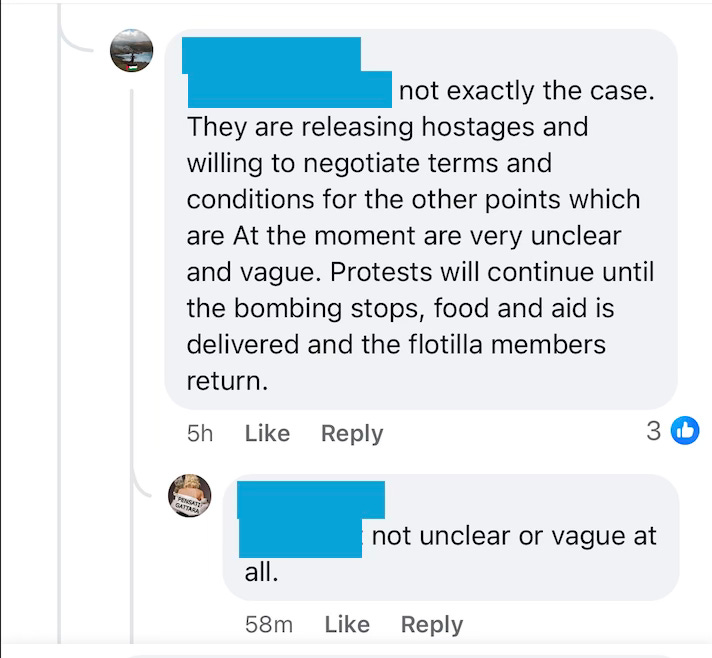
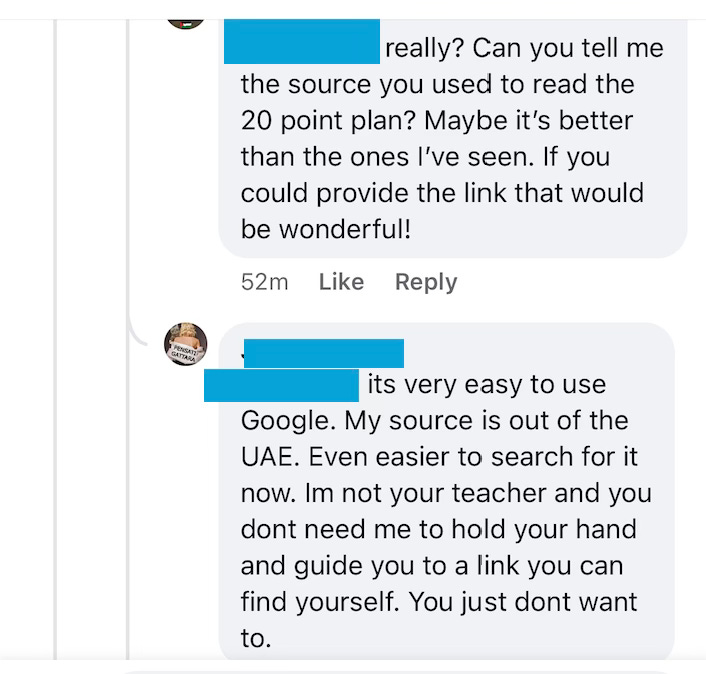
As you can see I tried to give the person the opportunity to back up their statement and I admitted I might not know all the answers. Maybe they inferred a sarcastic tone? Nevertheless the person descends quickly into self-righteousness and insults.
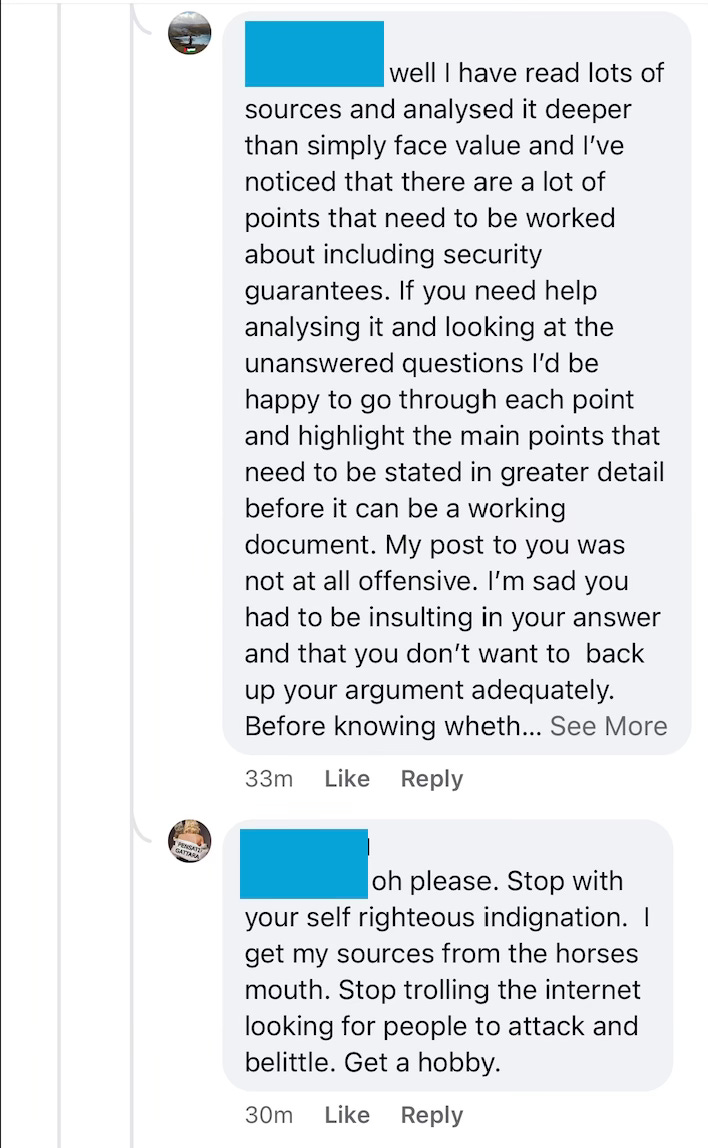
My response was a bit lengthy I know! Note they shift reality, continue with insults and try to label me as the troll.
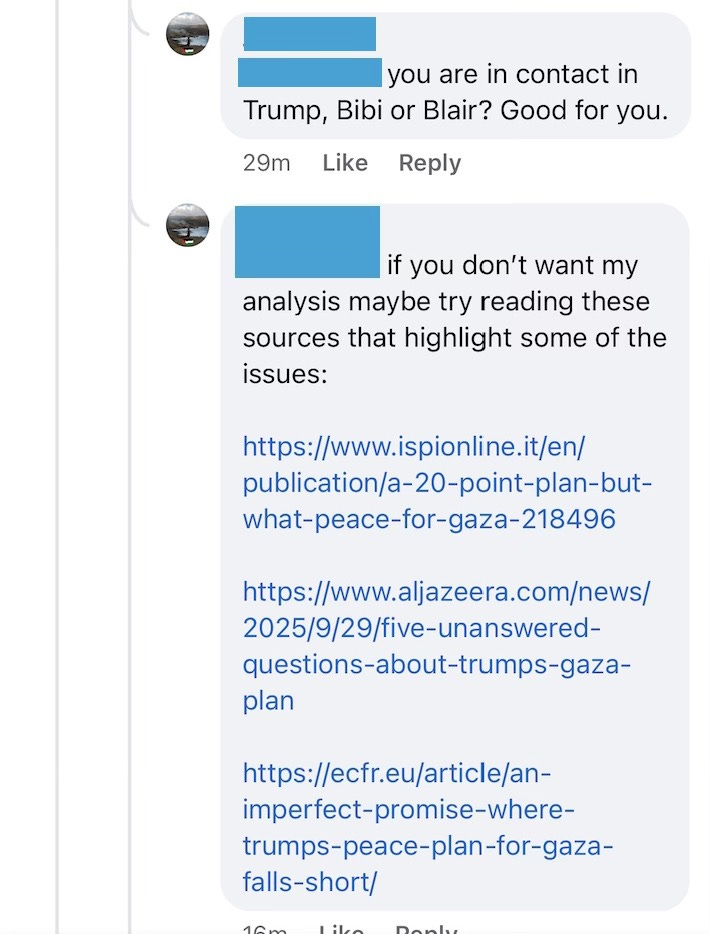
Ok I made one sarcastic comment (I couldn’t resist) before providing the silent readers with links they can use to inform themselves on the issue. The commenter never replied to me…
Their original comment of “not unclear or vague” could have been a genuine person who had read the peace plan and thought it was ok, but from the following comments it became clear this was not a good person to engage with. I only kept going to model good commenting behaviour for the silent readers as it was on really divisive issue where it was difficult to find objective information. I also had in mind it could be someone who was triggered my comment.
Let me know if you thought my original comment came across as facetious. That’s the problem with text, it’s missing the tone you intend!


